Eye Doctor vs Oculoplastic Surgeon: Who Should You See?
What is the difference between an eye doctor and an oculoplastic surgeon? Find a verified specialist in Dhaka with the right credentials. Start here, Levree Health.
Picture this: you visit an eye doctor in Dhaka, mention that your eyelid has been drooping for months or that your eye waters constantly, and they tell you surgery is needed. They refer you to a "specialist," and you walk out of the clinic with a name on a piece of paper and no idea what kind of surgeon you are looking for. This happens more often than it should.
If you are asking what is the difference between an eye doctor and an oculoplastic surgeon, the short answer is training, surgical volume, and the conditions each is qualified to treat surgically. The gap between a general ophthalmologist and an oculoplastic surgeon is significant, choosing the wrong one does not just waste your time; it can mean the wrong procedure, a poor outcome, or a longer recovery than necessary. This article breaks down that difference clearly. It covers the conditions and procedures involved, explains the risks, and tells you how to verify a surgeon's credentials in Bangladesh before you book anything.
What is the difference between an eye doctor and an oculoplastic surgeon?
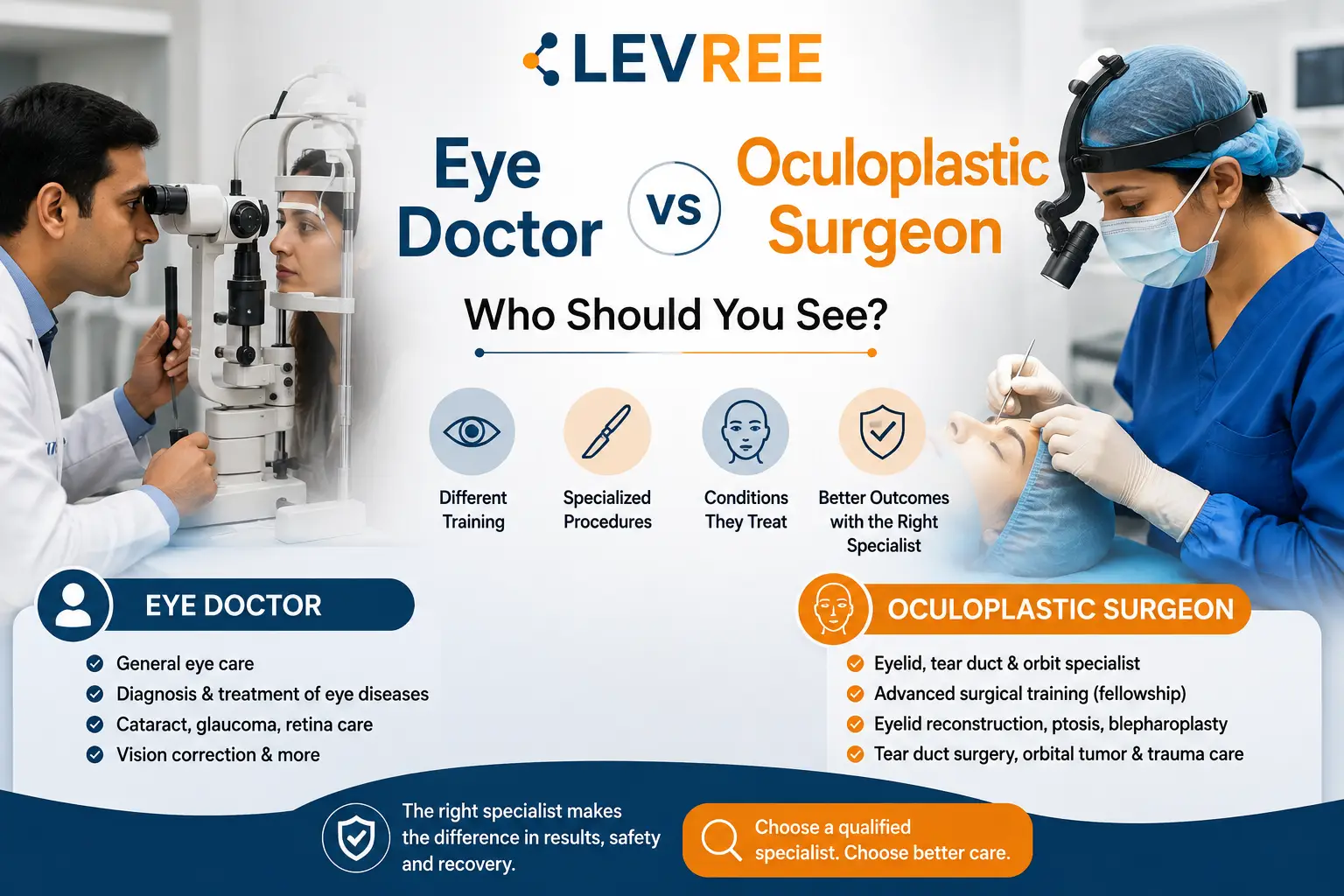
An ophthalmologist is a fully qualified medical doctor who specialises in the diagnosis and surgical treatment of eye disease. Their training includes medical school, a one-year internship, and a three-year residency covering the full range of eye conditions: cataracts, glaucoma, diabetic retinopathy, macular degeneration, and vision correction surgery. By the end of that residency, they are competent physicians and surgeons for the eye itself.
An oculoplastic surgeon begins their career as a fully trained ophthalmologist. What separates them from their peers is an additional two-year fellowship in oculofacial plastic and reconstructive surgery, a sub-specialisation focused exclusively on the eyelids, the bony eye socket (the orbit), the tear drainage system, and the surrounding upper face. It is not a separate profession; it is a layer of expertise built on top of ophthalmology.
For most patients in Bangladesh, a general ophthalmologist is exactly who they need to see first. Routine eye examinations, prescription glasses, cataract operations, and the ongoing management of chronic eye diseases all sit firmly within their scope. Think of the general ophthalmologist as your starting point for any new eye concern. Their job, among other things, is to assess whether what you are experiencing requires specialist intervention or whether they can manage it themselves.
What sets an oculoplastic surgeon apart
The fellowship is intensive in a way that matters practically. A trainee oculoplastic surgeon performs hundreds of supervised eyelid procedures before practising independently, far more than a general ophthalmologist, who may have completed very few specialised eyelid operations during residency. This surgical volume gap is the most practical reason why complex eyelid and orbital conditions produce better outcomes in oculoplastic hands. Internationally, board certification through bodies like ASOPRS requires passing two sets of rigorous written and oral examinations, plus published original research, a standard well above general ophthalmology certification. For a practical list of the types of surgeries an oculoplastic surgeon performs you can review specialist society resources that summarise common procedures and indications.
In Bangladesh, fellowship-trained oculoplastic surgeons are genuinely rare. Recognised training institutions include the National Institute of Ophthalmology and Hospital (NIO&H) in Dhaka, and international programmes through institutions such as Wills Eye Hospital in the USA and ORBIS. The Deep Eye Care Foundation in Bangladesh offers an 18-month fellowship in Orbit and Oculoplasty that is recognised by the BMDC, a positive development for local training. But the overall number of qualified specialists remains small, which makes credential verification all the more important.
Conditions that point you toward an oculoplastic specialist
A general ophthalmologist can diagnose most eyelid and orbital conditions. Surgical correction of several of them is a different matter. The following conditions require an oculoplastic surgeon rather than a general eye doctor:
- Ptosis: a drooping upper eyelid that obstructs the visual field or affects appearance
- Entropion and ectropion: eyelids that turn inward or outward, risking corneal damage
- Eyelid trauma: lacerations or structural damage requiring precise reconstruction
- Suspicious lesions or skin cancers on or near the eyelid, requiring removal and reconstruction
- Functional or cosmetic blepharoplasty: removal of excess eyelid skin affecting vision or appearance
- Blocked tear ducts causing chronic watering, requiring dacryocystorhinostomy (DCR)
- Orbital conditions: tumours within the eye socket, thyroid eye disease requiring orbital decompression, and complex fractures
If your general eye doctor mentions any of these diagnoses, a referral to an oculoplastic surgeon is the appropriate next step. The general ophthalmologist has done their job by identifying the problem; the oculoplastic surgeon is the one trained to fix it surgically.
Common procedures and what recovery actually looks like
The main oculoplastic procedures
Blepharoplasty removes excess skin, fat, and lax muscle from the upper or lower eyelids to restore a clear field of vision or improve appearance. Ptosis repair tightens the levator muscle that raises the upper eyelid, correcting the droop. DCR (dacryocystorhinostomy) creates a new drainage channel between the tear sac and the nasal cavity to bypass a blocked duct. A small stent is placed temporarily to keep the passage open. Eyelid malposition corrections realign lids that have shifted inward or outward. Orbital and tumour surgeries are more complex and tailored to each individual case. For an accessible patient-facing overview of what oculoplastic surgery covers, see the Cleveland Clinic's guide to oculoplastics (oculoplastic surgery).
Recovery timelines and risks
Most patients return to routine activities within one to two weeks after blepharoplasty or ptosis repair. Complex orbital surgery may require several weeks. General surgical risks, infection, bleeding, and anaesthesia reactions, apply to all of these procedures. Oculoplastic-specific risks include temporary dry eye, asymmetry between the two eyelids, sensitivity to light, and in rare cases, temporary changes in vision. Patients are advised to avoid exercise and heavy lifting for approximately three weeks and to sleep with the head elevated during the first week to reduce swelling. Contact lenses and eye makeup should wait at least one to two weeks.
These risks are not reasons to avoid surgery when it is genuinely needed. They are reasons to ensure the surgeon performing the procedure has extensive supervised experience in that specific operation. The lower the case volume, the higher the risk of a suboptimal outcome.
Oculoplastic surgeon vs general plastic surgeon: why it matters
Patients sometimes assume that any plastic surgeon can handle eyelid surgery. A general plastic surgeon is legally permitted to perform cosmetic blepharoplasty, but their training is structured very differently. A general plastic surgeon learns to work across the entire body, breast surgery, rhinoplasty, body contouring, and much more. Eyelid surgery is a small component of a very broad curriculum, and their supervised eyelid case volume during training is typically far lower than an oculoplastic surgeon's.
The more important distinction is functional knowledge. An oculoplastic surgeon carries the full diagnostic training of an ophthalmologist into the operating theatre. They understand the tear film, the cornea, visual function, and the precise anatomy of the orbit in a way that a cosmetic surgery generalist simply does not. When something affects or risks the patient's vision, this knowledge is essential. For revision surgery, complex anatomy, or any case where eye function is a concern, an oculoplastic surgeon is the clearly safer choice. A general plastic surgeon operating near the eye without that background is working outside their area of deepest expertise. For a clear comparison of these roles and when to prefer an oculoplastic specialist, see this comparison by Cincinnati Eye & Ear, which outlines practical differences between the specialties: Oculoplastic surgeon vs plastic surgeon: overview.
How to find a verified oculoplastic surgeon in Bangladesh
Start with BMDC registration. Every surgeon legally practising in Bangladesh must hold a valid Bangladesh Medical and Dental Council registration. You can verify any surgeon's registration number at verify.bmdc.org.bd by entering their six-digit BMDC registration number. The system is public and requires no login. It confirms the surgeon's name, qualifications, and registration status.
Beyond registration, look specifically for qualifications that include FCPS (Eye) and, critically, a documented fellowship in oculoplasty or orbit surgery. These are not the same thing. An FCPS (Eye) confirms specialisation in ophthalmology; the fellowship confirms sub-specialisation in oculoplastics. Ask the surgeon directly where they completed their fellowship training and how many procedures of your specific type they perform each year. If they cannot answer those questions clearly, that is informative.
At your first consultation, bring these questions with you:
- Where did you complete your oculoplastic fellowship, and for how long?
- How many procedures of this type do you perform each year?
- What is your protocol if a complication affects my vision during or after surgery?
- Can I see before-and-after examples of patients with a similar condition?
Rather than navigating hospital websites individually, patients in Dhaka can use Levree Health's specialist directory to browse verified oculoplastic surgeons listed with their qualifications, hospital affiliations, and areas of expertise, all in one place. Levree Health was built specifically for the Bangladeshi patient who does not know where to start. The directory is designed to remove the guesswork from finding a specialist with the right training for the right condition. You can also browse our Uncategorized Archives for related posts and patient stories.
The clearest takeaway: what is the difference between an eye doctor and an oculoplastic surgeon?
An ophthalmologist is your first point of contact for most eye concerns. They are qualified, experienced, and the right starting point for the vast majority of patients. An oculoplastic surgeon is a fellowship-trained sub-specialist for conditions involving the eyelids, tear ducts, and orbit, and the difference in training and surgical volume is real. It matters for your outcome.
Start with a general eye doctor. If they identify a condition requiring surgical intervention in the eyelid, tear duct, or orbit, ask for a referral. Then verify that the referred surgeon holds documented fellowship training in oculoplasty, not just general ophthalmology qualifications. That one extra check is what separates an informed patient from one who accepts the first name on a referral slip.
If you are ready to find a verified specialist in Dhaka, the Levree Health directory is a practical place to begin. It is built for exactly this kind of search: specific, credential-conscious, and grounded in the Bangladeshi healthcare context. For broader reading on ophthalmology topics, visit our Ophthalmology Archives to explore more articles.